Hello everyone, I am Wang Chuansheng. Through the WaterDoctor platform, I am delighted to share some thoughts with customers and audiences on the topic of simultaneous nitrification–denitrification (SND). In wastewater treatment/water reuse facility and modern high-density recirculating aquaculture systems (RAS), nitrogen management often resembles a never-ending “detoxification race.” Whether the issue is ammonia or nitrite, even slight fluctuations above the safe threshold may lead to catastrophic mortality in fish, shrimp, or crabs for aquaculture operators, while for environmental engineers, such fluctuations translate directly into the risk of effluent non-compliance. Strictly speaking, SND is not a new concept. When I studied at Peking University as a master and later pursued my PhD and postdoctoral research at National University of Singapore (NUS), this topic was already a major research focus. However, in retrospect, SND was historically regarded more as an “engineering coincidence” than as a biologically integrated function. With the rapid advances in molecular microbiology and synthetic biology in recent years, it has become increasingly clear to me that SND is now undergoing a profound paradigm shift—from a phenomenon enabled by **spatial coincidence** to one driven by **genuine functional integration**. ### 1. Saying Goodbye to Spatial SND 1.0: The Era of Microenvironmental Compromise If we revisit the classical textbooks and early engineering practices of several decades ago, SND was defined as the simultaneous occurrence of nitrification and denitrification within the same reactor. At that time, the central theoretical foundation was the concept of the **oxygen diffusion gradient**. Activated sludge flocs or biofilms may be visualized as an onion. As oxygen diffuses inward, it encounters increasing mass transfer resistance, thereby creating a dissolved oxygen (DO) stratification from the outer surface toward the inner core: - **Outer layer (aerobic zone):** Oxygen is abundant, and autotrophic nitrifiers oxidize ammonia to nitrite to nitrate (Aerobic Nitritation and Nitrification: $NH_4-N$→$NO_2-N$→$NO_3-N$). - **Inner core (anoxic zone):** Oxygen is depleted by the outer layer, forming an anoxic region in which heterotrophic denitrifiers reduce nitrate, to nitrite to nitrogen gas (Anaerobic or Anoxic Denitrification: $NO_3-N$→$NO_2-N$→$N_2$). 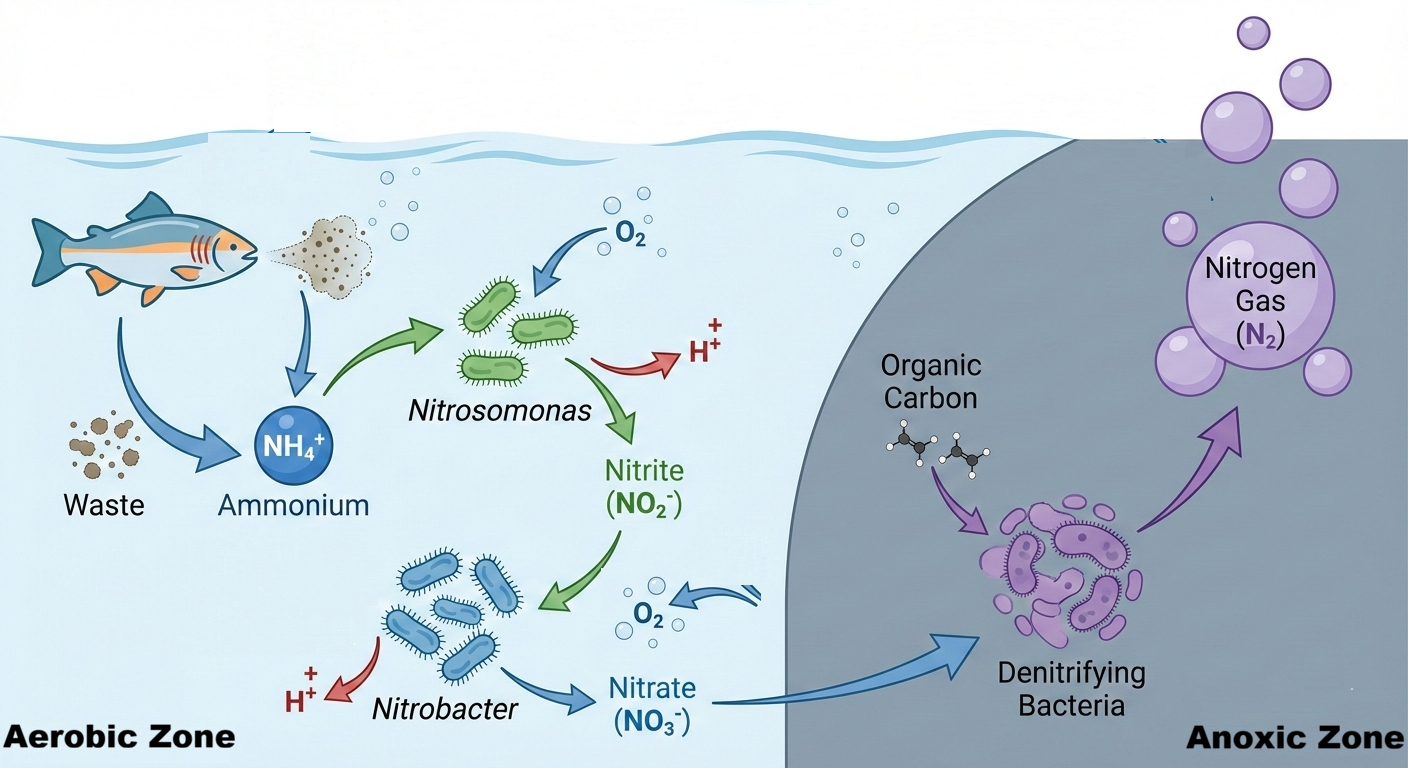 A similar principle applies to the now increasingly popular **membrane-aerated biofilm reactor (MABR)**, although the oxygen diffusion direction is reversed, i.e., from the membrane interior outward. The inner layer adjacent to the aerated membrane remains aerobic and supports nitritation and nitrification, whereas the outer region may become oxygen-limited and supports denitrification. In this way, nitrification and denitrification can occur within the same reactor. This configuration may be regarded as “**SND 1.0**.” Its essence lies in the forced assembly of complementary nitrogen transformation functions through physical spatial partitioning. In practical operations, this balance is extremely fragile. While participating in large-scale wastewater treatment pilot tests, I often found that if the DO was slightly high, oxygen would "pierce" straight through to the core, causing denitrification to strike immediately. If DO was slightly low, the nitrification rate would slow down frustratingly. This collaboration, which relies on physical barriers, is essentially an unstable "meta-stable state" that is difficult to maintain robustly under long-term industrial loads. ### 2. The Paradigm Shift: The Multifunctional Performance of Next-Generation SND Consortia The logic behind the new generation of SND is fundamentally different. It builds on four years of strain isolation by Dr. QK (a senior colleague in Professor He Jianzhong’s group during my postdoctoral training), followed by nearly three additional years of my own efforts in further SND enrichment and validation. Rather than painstakingly manipulating oxygen diffusion gradients or controlling sludge particle size to create aerobic and anoxic niches, we now turn directly to a class of “specialized functional performers”: multifunctional SND microorganisms coupling **direct ammonia oxidation (Dirammox) and heterotrophic nitrification–aerobic denitrification (HNAD).** What is remarkable about these microorganisms is that they are capable of executing the entire denitrification sequence at the single-cell level—or even under fully aerobic conditions. 