Against the macro-backdrop of explosive global population growth and the near depletion of natural capture fisheries, aquaculture has emerged as the core pillar supporting the high-quality protein supply for humanity. Data indicates that over the past few decades, aquaculture has been one of the fastest-growing food production sectors, with its annual growth rate historically approaching 10%, significantly outperforming the 3% of traditional livestock farming and the 1.6% of capture fisheries. However, accompanying the proliferation of high-density intensive farming models, irreconcilable ecological pressures and water quality deterioration have become increasingly prominent. Among these, nitrogen pollution within the aquaculture water column (primarily manifesting as the continuous accumulation of highly toxic ammonia nitrogen and nitrite) acts not only as a physicochemical bottleneck limiting biomass productivity but also as the primary instigator of large-scale disease outbreaks, eutrophication in surrounding aquatic systems, and severe threats to human food safety. To fundamentally resolve this systemic contradiction, the global aquaculture water treatment system market, particularly Recirculating Aquaculture Systems (RAS), is experiencing unprecedented growth. Under traditional open-pond farming models, the sole mitigation strategy for water quality deterioration is high-frequency, large-volume water exchange. This not only consumes exceedingly precious freshwater or coastal clean water resources but also inevitably discharges wastewater heavily laden with undigested feed, excrement, chemical agents, and antibiotic residues directly into natural ecosystems. In contrast, modern RAS facilities utilize highly integrated internal water treatment mechanisms capable of reducing water exchange volumes by 90% to 99%, thereby achieving maximum closed-loop resource utilization. From a quantitative market perspective, the global aquaculture water treatment and RAS market reached an estimated valuation of \$7.05 billion in 2024, is projected to climb to \$7.734 billion by 2025, and is expected to surpass the \$14.3 billion mark by 2034, registering a compound annual growth rate (CAGR) of 8.9%. Using broader statistical parameters, certain industry analysts forecast that this market will reach \$21.63 billion in 2025 and surge to \$48.42 billion by 2032, exhibiting a remarkable CAGR of 12.2%. This vast and rapidly expanding market is dominated by several multinational conglomerates, such as AKVA group, Pentair PLC, Veolia Group, and Water Management Technologies, demonstrating both highly concentrated and technology-intensive characteristics. Concurrently, the market for water quality testing instruments and reagents (including test kits, digital meters, and sensors targeting pH, dissolved oxygen (DO), ammonia nitrogen, and nitrite) is experiencing substantial incremental growth. Driven by this massive influx of capital and technology, an exceedingly complex array of ammonia nitrogen and nitrite removal products has emerged, ranging from simple physical mineral adsorbents and potent chemical oxidants to complex genetically engineered microbial formulations and automated biological filters. Nevertheless, not all technological pathways can successfully balance economic viability with long-term ecological resilience and stringent food safety compliance. This report aims to deconstruct the microscopic mechanisms of these mainstream nitrogen removal technologies from the standpoint of first Principles. By utilizing ecological resilience and human food safety standards as baseline metrics, this report provides an in-depth analysis and comparative evaluation of various technological routes. Ultimately, this report introduces a representative frontier technology enterprise—Singapore's WaterDoctor (and its strategic partner, Singapore Aquaculture Technologies)—to comprehensively analyze the commercial and technical value of its AI-driven Simultaneous Nitrification-Denitrification (SND) biological technology. 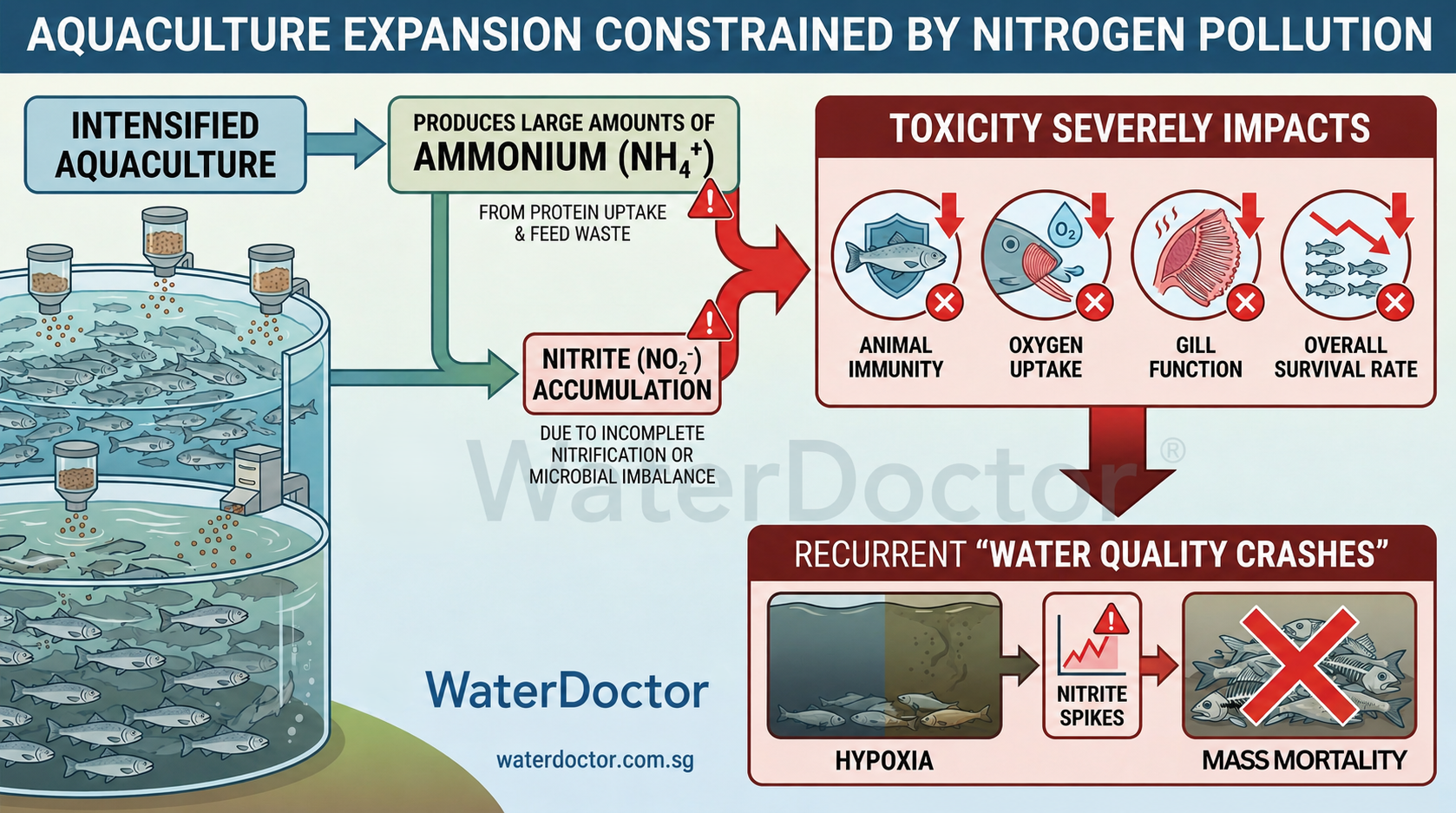 ## I. Pathogenic Mechanisms and First Principles Analysis of Aquaculture Nitrogen Pollution ### 1.1 The Underlying Mechanisms of the Nitrogen Cycle and Energy Metabolism The nitrogen cycle (N-cycle) serves as the cornerstone for maintaining global biogeochemical equilibrium. In nature, nitrogen gas ($N_2$) is converted into ammonia ($NH_3$) via nitrogen fixation, subsequently integrating into complex biological metabolic networks. Within the specific microenvironment of aquaculture, nitrogen input primarily originates from high-protein artificial formulated feeds. However, constrained by the intestinal digestion and absorption efficiencies of fish and crustaceans, up to 75% of the nitrogenous nutrients introduced via feed cannot be assimilated into harvestable animal biomass.